Mushroom Lamp vs Dome Lamp: Compare the Whole Silhouette
These shape labels can overlap. Compare the cap, support and visible light source rather than expecting a name to predict performance.
By Lumière Light Studio Editorial
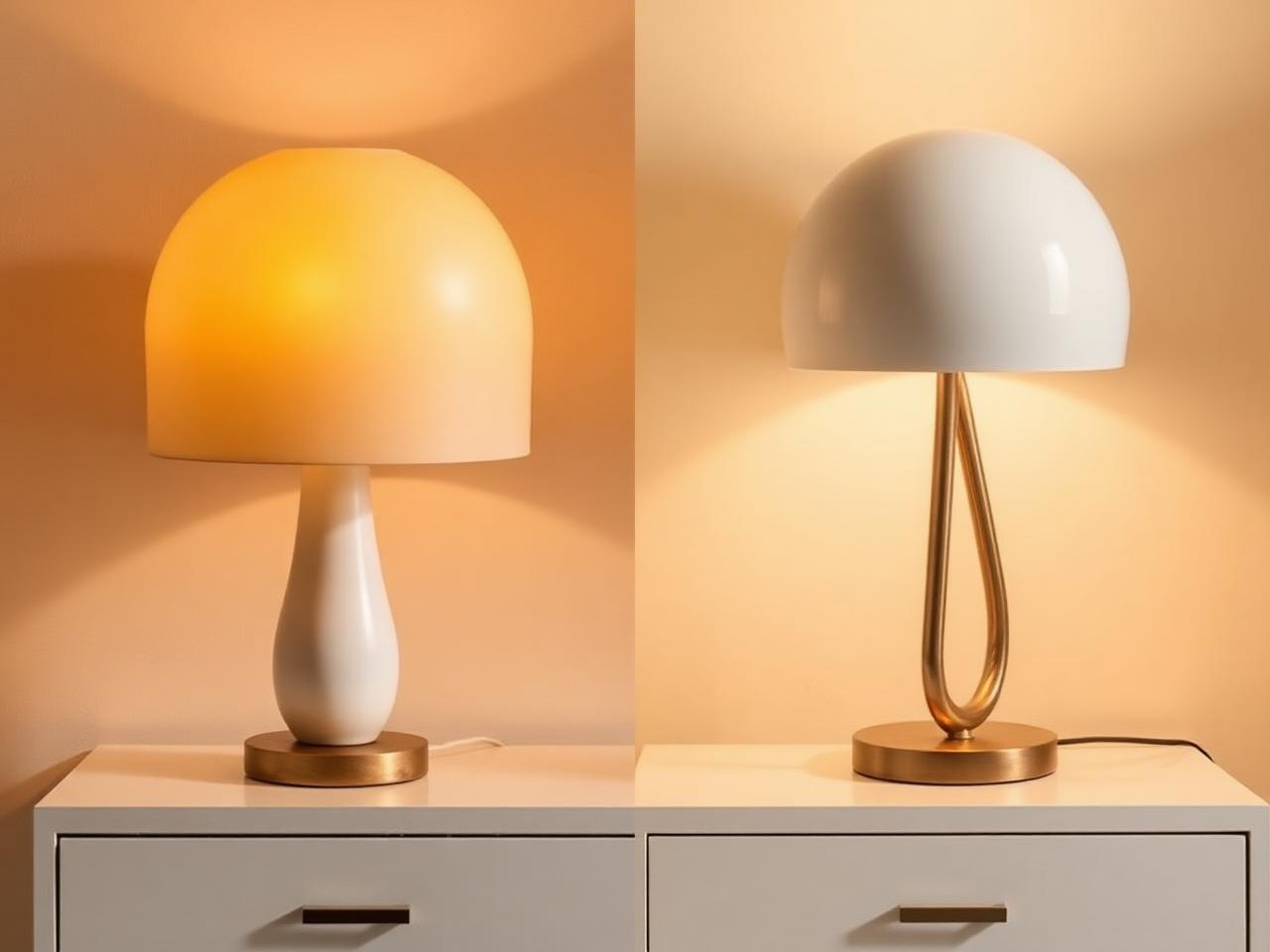
Two lamps can both have rounded shades and still look quite different. One may suggest a cap rising from a continuous stem; the other may read as a hemisphere resting on a separate support. Mushroom and dome are useful visual shorthand, but they are not strict technical categories.
Start with the outline rather than treating the labels as a fixed either-or choice. A lamp described as mushroom-like may also have a dome-shaped shade. Retail descriptions can overlap, and the same broad label can cover very different proportions and materials.
Compare the relationship between shade and support
A mushroom-like silhouette usually suggests a broad cap above a narrower stem. The transition can look continuous or clearly divided. A dome description primarily concerns the rounded shade; the support beneath it might be slender, open, broad or visually separate.
Look at how much space is visible under the shade, how far the cap extends and where the widest point falls. Those relationships often explain your preference more accurately than the product category. A low cap may read as compact even when it occupies substantial tabletop space.
| Visual question | What to compare |
|---|---|
| Does the form look continuous? | The transition between cap and support |
| Does it feel broad or upright? | Overall width relative to overall height |
| Does the support remain visible? | The space beneath and around the shade |
| What draws attention when lit? | The visible source, shade and openings |
The shape label does not predict the light
A rounded shade can be transparent, translucent or opaque. The source may be hidden from one angle and visible from another. Openings, finish and source position affect the result, so a dome cannot be assumed to spread light farther than a mushroom-like form.
Consider the place you will actually use it. From a nearby chair, can you see a bright source beneath the shade? From the doorway, does the lamp appear as a glowing surface or mostly as an outline? These observations are more useful than assigning one shape to a bedroom and another to a living room.
If the lamp will sit near books or a work surface, assess the light reaching that surface separately. A decorative shape does not establish that the lamp will provide suitable illumination for a detailed activity.
Choose proportions that leave the surface usable
Check the widest part as well as the base. A cap can extend towards a walkway or occupy space needed for a tray even when the footprint is small. Use the listed overall dimensions to understand that reach before deciding the lamp is compact.
Compare the unlit outline against nearby furniture and wall objects. Curves can echo another rounded object, while a visibly separate support can introduce a different rhythm. There is no requirement to match the room to a named style.
No specific Lumière lamp is classified here as mushroom-shaped. For your own comparison, write down the proportions and source visibility you prefer, then check those features on each candidate. Keep the shape name as a search aid, not as the final reason to choose.
The Editor's Notes
Get the Lumière styling notes
One quiet essay a month on layering light and shaping the atmosphere of a room. No noise. Unsubscribe anytime.
The Editor's Notes
One essay. One piece. Once a month.
Quiet dispatches from the studio. Unsubscribe anytime.
For the hour after
For the hour after the overhead light goes off
Shop lamps built for the quiet part of the evening.
Share this guide