Lower-Light Rooms: Keep Contrast Without Losing Useful Light
Create a more selective evening arrangement while retaining the light needed for moving around and everyday activities.
By Lumière Light Studio Editorial
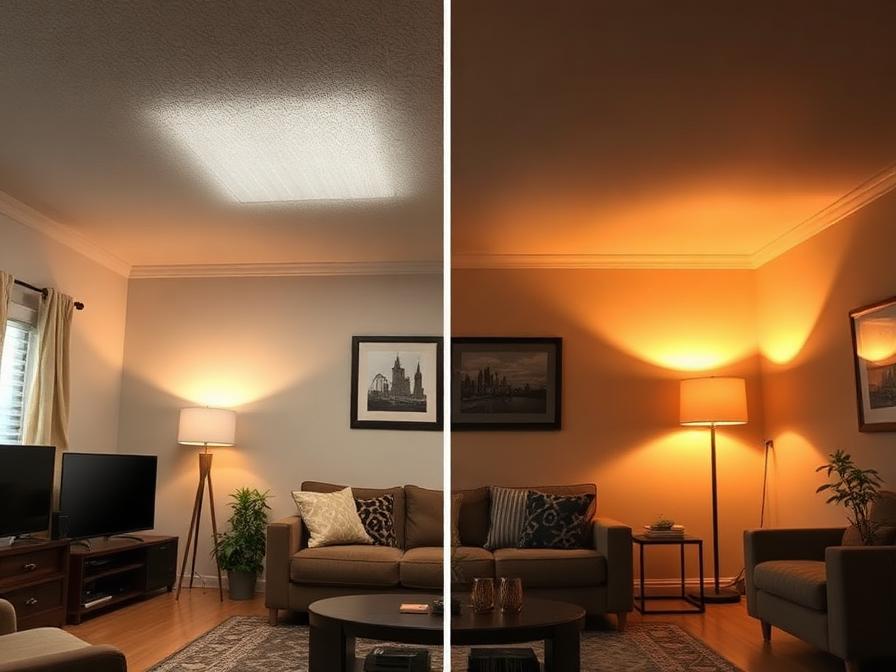
A room does not have to look equally bright in every corner. You may prefer a lit side table against a quieter background, or a few distinct areas rather than a broad wash of light. That is a visual preference, not a version of a screen setting and not a promise of health benefits.
The practical challenge is deciding where less light is welcome and where it becomes inconvenient. Start with the activities that still need to happen. The arrangement should support the way you use the room, even when its appearance is deliberately subdued.
Keep useful light before reducing the rest
Identify the places you need to see clearly: a route through the room, the objects on a table, and any activity surface. Retain the sources that make those places usable. A decorative lamp may contribute to the setting without providing enough illumination for a book or detailed work.
Ceiling lights do not need to be ruled out. If one makes the room practical while other lights provide the appearance you like, use both. There is no fixed lamp count that works for every room, and two rooms of similar size may need different arrangements because their furniture and uses differ.
Reduce one source at a time
Compare the room with its usual lights, then switch off one source that is not needed for the activity at hand. Look at what changes before removing another. You may find that a single corner becomes more distinct while the rest of the room remains usable.
Do this from your actual seats rather than judging only from the doorway. Check what happens when you look toward the lamp and then toward the surrounding furniture. If the contrast feels distracting, restore some background light or change the lamp's position. A darker setting is not an achievement in itself.
Keep the arrangement easy to live with
Check the route between seats, doors, and the surfaces you use. If something becomes difficult to find or navigate, bring back light there. Do not use an appealing photograph as evidence that the same arrangement will work for ordinary movement in the room.
Controls also matter. A light that looks right but is awkward to reach may be inconvenient in daily use. Arrange the furniture so the lamp remains supported, the control is accessible as intended, and its cable does not cross a walking route. Use only the cable or adapter the listing or manufacturer specifies; ask support if the requirements are unclear.
Review the room as activities change
The light you prefer while listening to music may not suit reading, tidying, or finding a dropped object. Keep a straightforward way to restore the room's more practical lighting. An evening arrangement can be temporary and activity-specific rather than a permanent rule for the whole home.
There is no need to justify lower light with claims about hormones, focus, or recovery. If you like the appearance, test it within the room's actual needs. Begin with one seat and its nearby surface, compare two arrangements, and keep the version that combines a comfortable view with useful illumination.
The Editor's Notes
Get the Lumière styling notes
One quiet essay a month on layering light and shaping the atmosphere of a room. No noise. Unsubscribe anytime.
The Editor's Notes
One essay. One piece. Once a month.
Quiet dispatches from the studio. Unsubscribe anytime.
For the hour after
For the hour after the overhead light goes off
Shop lamps built for the quiet part of the evening.
Share this guide