Choosing a Lamp for a Period Home Without Matching Every Era
Use mouldings, existing fixtures and furniture proportions to choose a lamp that belongs without becoming a replica.
By Lumière Light Studio Editorial
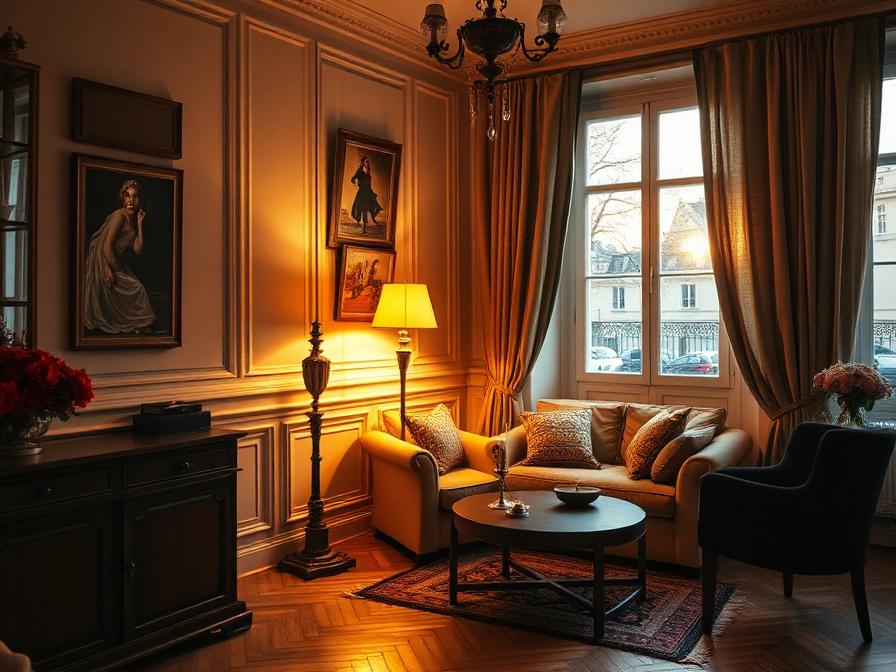
Cornices, panelled doors and an existing ceiling fixture already give a period room a strong visual vocabulary. A new lamp does not have to repeat all of it. The more useful question is whether the lamp has an intelligible place among those lines, at the scale of the furniture you use.
Treat the home's features as visible conditions rather than a test of historical correctness. This approach does not depend on establishing a lamp's age, origin or authenticity. A contemporary piece can be considered on its shape and relationship to the setting.
Measure against furniture before looking up at the ceiling
A tall room can tempt you towards a large lamp, but the supporting table may still be narrow. Begin with its usable width and depth, the objects that remain there and the lamp's complete outline. Leave the full base supported and maintain the clearances required by its manufacturer.
Then step back. Compare the proposed height with nearby furniture, framed art and the lower edge of a mirror. A simple paper outline held in position can help judge scale before a purchase; remove it before placing or operating a lamp. Do not derive proportions from a room photograph with unknown dimensions.
High ceilings do not mean each object must reach upwards. A lower lamp can make a deliberate foreground below tall architecture. Conversely, a very small silhouette may disappear against large panels. Decide which relationship you prefer rather than following a fixed height ratio.
Let mouldings remain readable
Look at where the shade outline crosses dado rails, panel edges or a decorative overmantel. An almost-aligned edge can make a composition look accidental. Try a suitable position where the lamp either sits clearly within a field or crosses a line decisively.
Detailed mouldings often provide enough pattern without a densely ornamented lamp beside them. A simpler shade can leave those details legible. In a plainer part of the same room, a more sculptural outline may have room to register. Neither choice requires making the whole home one style.
Check the unlit view too. Daylight may reveal an awkward overlap that the illuminated shade distracts from in the evening. Keep the arrangement that works as an object as well as a source of light.
Give mixed eras one visible connection
Choose a connection to the existing ceiling or wall fixtures: a curved line, a repeated dark accent or a related finish. Repeating one element can be enough. Matching every metal and shade shape can make the choice more restrictive than the room needs.
If the existing fixture is elaborate, compare a restrained lamp against another decorative piece. Ask which allows the architecture and furniture to remain distinct. This is a comparison of visual weight, not a claim that one period belongs with another by rule.
Do not alter existing fixtures or route cables across doorways to secure a preferred composition. Work from suitable surfaces and accessible controls. Keep useful room lighting in service while assessing the new accent.
Photograph the candidate position from the doorway, then judge it from your regular seat. Note one relationship worth keeping and one collision to resolve. Measure the supporting surface before turning that observation into a shortlist.
The Editor's Notes
Get the Lumière styling notes
One quiet essay a month on layering light and shaping the atmosphere of a room. No noise. Unsubscribe anytime.
The Editor's Notes
One essay. One piece. Once a month.
Quiet dispatches from the studio. Unsubscribe anytime.
For the hour after
For the hour after the overhead light goes off
Shop lamps built for the quiet part of the evening.
Share this guide