Fixed-Brightness or Dimmable: Read What the Control Adjusts
Decide whether adjustable brightness would serve a real use, then check whether the product page actually describes brightness adjustment.
By Lumière Light Studio Editorial
The word touch tells you how a control is operated, not necessarily what it changes. It might switch a lamp on and off, change a colour setting, adjust brightness, or combine functions. A useful comparison starts by identifying the adjustment you actually need.
Fixed brightness can be entirely suitable when a lamp serves one stable role. Adjustable brightness becomes more useful when the same source needs different levels in normal use. This is a choice about function, not a ranking in which more settings automatically make a better lamp.
Name the change you want before choosing a control
Consider a lamp beside a chair. You might want its presence as a quiet accent at one time and more light on the surrounding area at another. That is a reason to investigate brightness adjustment, though dimming does not establish whether the lamp provides enough useful light for a specific task.
Alternatively, a lamp on a console may be used in much the same way each evening. If one level suits that role, an on/off control may be sufficient. Other existing lights can still be used independently. A room does not require every source to offer the same adjustments.
Write down the two situations that would call for different brightness. If they are hard to name, do not add dimming to the brief solely because it sounds desirable. If the change you want is from a warmer to a cooler white, that is a colour-temperature question instead.
Control descriptions answer different questions
| Wording on a page | What it describes | What still needs checking |
|---|---|---|
| On/off | Switching the light on and off | Whether a separate brightness adjustment is specified |
| Touch control | A way to operate the control | Which function the touch action performs |
| Colour settings | Choices of light colour | Whether brightness can also change |
| Adjustable brightness | A brightness adjustment | Whether it uses steps or a continuous range |
| Dimmable | An ability to adjust brightness | How the adjustment is operated and what the page confirms |
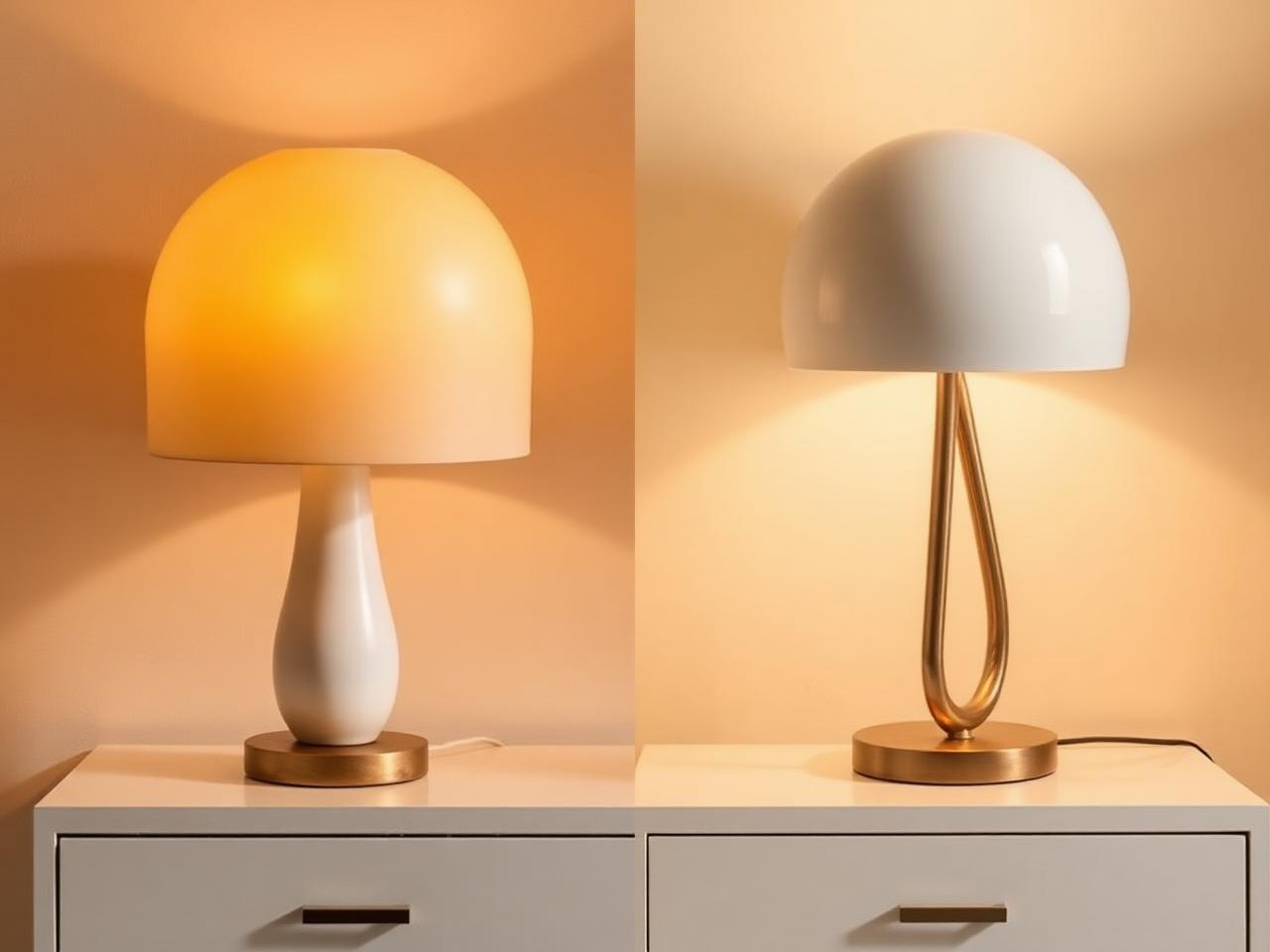
Read these descriptions together rather than allowing one word to stand in for the rest. An image of a button does not explain its functions. Nor does a photograph of a softly glowing shade establish that its output can be turned down.
A useful range matters more than the label alone
If the page confirms adjustable brightness, look for a description of how the levels are selected. Some controls use distinct settings; others offer a range. Do not assume either approach, or an especially low minimum, from the word dimmable by itself.
The adjustment also needs to suit how you use the space. Think about whether you want a quick choice between levels or finer adjustment. This is not a reason to infer any particular Lumière model’s functions. Check the current product page and ask support when the description leaves the operation unclear.
This comparison concerns the control described for the product, not adding an external dimmer. It offers no basis for modifying a lamp or assuming compatibility with another control system. Keep the decision within the functions explicitly documented for the lamp.
Treat missing information as a question
A missing dimming description does not justify inventing a capability. Equally, a vague control label is not enough to explain the full operation. Ask whether brightness changes, how it changes, and what information is available about the range. Keep colour adjustment as a separate question.
Before deciding, return to the situations you wrote down. If they genuinely call for different light levels, seek a clearly documented brightness control. If one level serves the intended role, a fixed-brightness option can remain in consideration. The next step is confirmation of the function you need, not a claim that a specific lamp has it.
The Editor's Notes
Get the Lumière styling notes
One quiet essay a month on layering light and shaping the atmosphere of a room. No noise. Unsubscribe anytime.
The Editor's Notes
One essay. One piece. Once a month.
Quiet dispatches from the studio. Unsubscribe anytime.
For the hour after
For the hour after the overhead light goes off
Shop lamps built for the quiet part of the evening.
Share this guide